Viking Range Burner Clicks But Will Not Light
A Viking surface burner that sparks endlessly without catching is usually a seating or contamination problem, not a dead spark module. How to tell the two apart in ten minutes before you pay anyone in Bothell.
- Written by
- Arthur Benedetti
- Experience
- 12 years
- Position
- Service technician — dishwashers and drainage
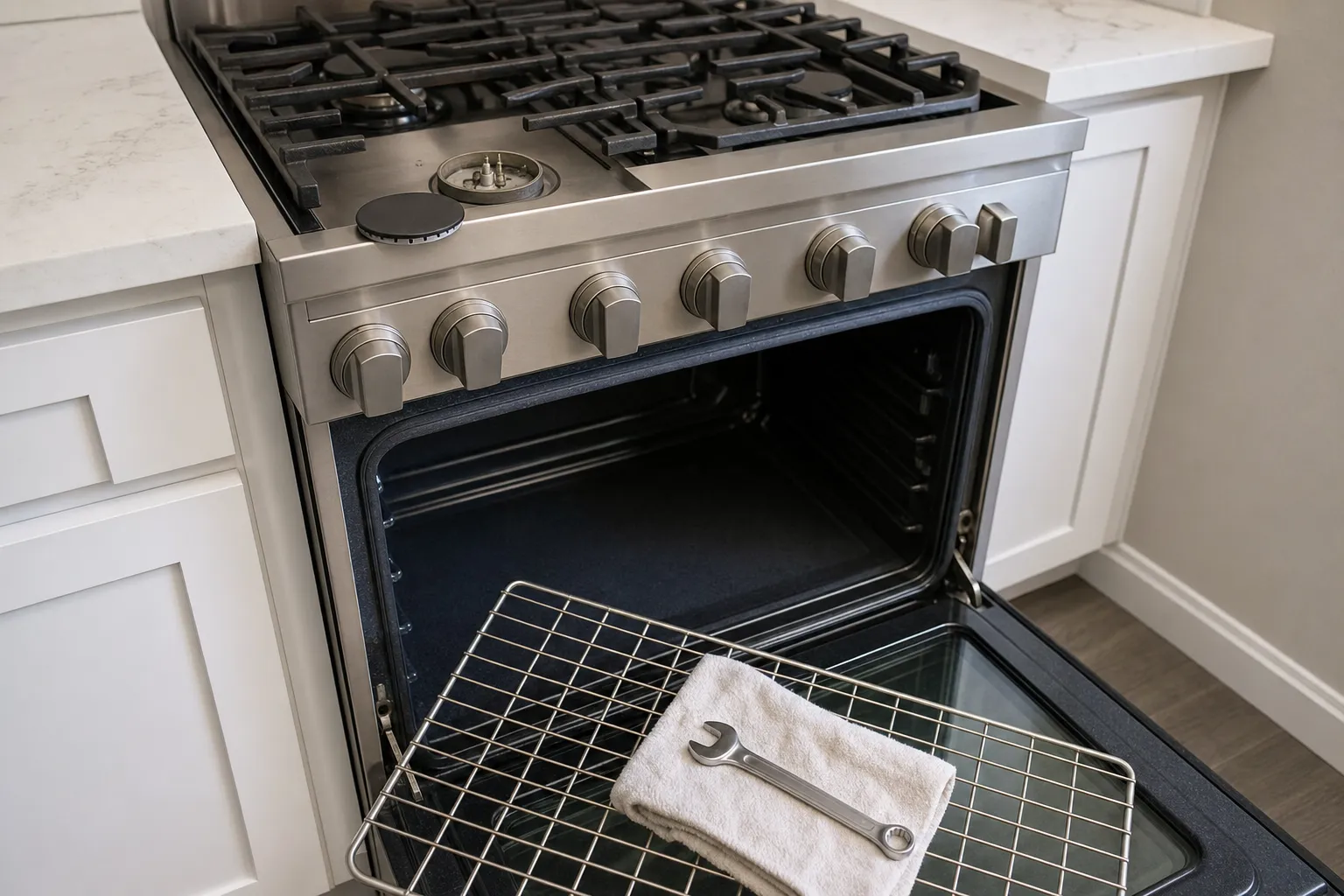
The sound is the giveaway, and almost everybody reads it backwards. A Viking surface burner that sparks on and on without ever catching is among the jobs we run most often in Bothell, and it is also the one most likely to finish with a part on the invoice that had nothing wrong with it. The clicking is the spark module doing its job. Something else is stopping the gas and the spark from meeting.
Before you book anyone — us included — there are three checks that resolve this fault outright more often than not. All of them are free and none of them require tools beyond a dry cloth.
What the clicking actually is
Two things happen in the same movement of the knob. Reaching LITE trips a switch behind the control panel, and the module answers it with high voltage down to a ceramic-insulated electrode sitting in a small notch beside the burner base. Simultaneously the valve opens, and gas travels up through the burner head to the ports around its rim.
Ignition happens when the spark crosses to the grounded burner base and there is gas at that exact spot. Break either half of that and you get a burner that sparks forever without catching. The spark is audible, which is why people assume the electrical side is fine and the gas side is broken — but the usual failure is mechanical and sits somewhere between the two.
Worth knowing: on almost every Viking cooktop the module fires all electrodes simultaneously. Every burner clicking when you only turned on one is normal.
The three things to check before calling anyone
Do these in order. They cost nothing and they solve this complaint most of the time.
1. Reseat the burner cap. Lift it off, look at the burner head underneath, and set the cap back down square. It should drop into place with no rocking and no visible gap on any side. A cap sitting a millimetre proud on one edge pushes the gas away from the electrode notch, and the spark then has nothing to ignite. This alone accounts for a large share of the calls we run.
2. Clear the ports. The small holes around the rim of the burner head block with boil-over, sugar and carbonised oil. Look across the rim at eye level — you want an even ring of clean openings. Clear anything blocked with a straightened paperclip or a stiff brush, never a drill bit or anything that widens the hole. Pay particular attention to the port nearest the electrode; that is the one that has to light first.
3. Dry everything. If the fault started after a spill, a boil-over or a cleaning session, the electrode is almost certainly wet. Water on the ceramic insulator gives the spark an easier path to ground than the air gap, so it discharges harmlessly and you hear clicking with no ignition. Leave the burner apart for a few hours, or run a hair dryer over it on a cool setting, and try again.
If all three are done properly and the burner still will not light, the problem is genuinely in the appliance and worth a diagnostic.
When the spark module really is the problem
Modules do fail, but they tend to fail in recognisable ways rather than mysteriously.
A dead module produces no clicking at all on any burner. That is a different symptom from the one this guide is about — no sound means no spark attempt, and the module, its wiring or the switch in the knob is where to look.
A failing module usually clicks unevenly: a burst, a pause, a burst, or a rate that is noticeably slower than it used to be. Compare the sound to how the range behaved a year ago if you can remember it.
A cracked electrode insulator looks like a module fault but is not. Inspect the white ceramic sleeve closely under a light. A hairline crack lets the spark jump to the burner base early, so you hear a healthy click while the gap that matters gets nothing. The electrode is a cheap part; the module is not. This is exactly the distinction that gets missed when someone reaches for the expensive component first.
Gas-side faults that do not involve ignition at all
Some no-light complaints have nothing to do with sparking.
If the burner lights but the flame is yellow and lazy rather than a tight blue cone, or if it lights and then dies when you turn the knob down, the manifold pressure is likely wrong. That is a regulator or supply problem and it affects every burner on the range, not one.
If a range was converted for propane and the orifices were swapped without the regulator being set to match, you get poor ignition and poor flame quality together.
If the range was recently moved or reinstalled, check that the flexible connector behind it is not kinked. It happens more than you would expect when a unit gets pushed back into a tight cabinet run.
Anything involving gas pressure, orifices or the regulator is not a do-it-yourself job. Measuring manifold pressure needs a manometer and the knowledge of what the reading should be for your specific model and fuel type.
What we do on the call
We start with the cheap possibilities, in the same order as above, because it would be dishonest not to. Then the electrode gets inspected under light, the spark gap gets measured, module output gets checked, and manifold pressure is read at the port with the burner running.
That sequence usually names the fault inside twenty minutes. Sometimes it ends with us reseating a cap and charging the service call for a problem you could have fixed yourself — which is why the checks above are at the top of this page rather than the bottom.
Asked after reading this
I turned on one burner and every electrode is clicking. Is that a fault?
Most Viking spark modules fire every electrode on the cooktop at once. Simultaneous clicking is normal behaviour, not a fault. What matters is whether the burner you actually turned on lights.
Is it safe to keep using a burner that takes several seconds to catch?
Briefly, yes, but do not leave it. Delayed ignition lets unburned gas collect around the burner and light all at once. If a burner needs more than three or four seconds, shut it off and diagnose it.
Can I clean the spark electrode myself?
You can dry it and gently clear debris around it with the burner off and cool. Do not bend it, file it or soak it — the ceramic insulator cracks easily and a cracked insulator shorts the spark to the burner base.
rangeburnersignitiondiagnostics