Level Matters on the Valley Floor: Peat Soils
A Viking door that will not self-close in downtown Bothell is usually a level problem, not a hinge problem. The valley floor sits on deep, poorly drained peat and muck, and built-in appliances read floor movement as a fault.
- Written by
- Arthur Benedetti
- Experience
- 12 years
- Position
- Service technician — dishwashers and drainage
The question worth asking first
Before you price a hinge, a closer cam or a dishwasher pump, ask a duller question: is the appliance still level? On the Bothell valley floor that one question closes more calls than any parts diagnosis, because a built-in takes its geometry from the floor and from the cabinet run around it.
A freestanding appliance stands on adjustable feet in open space and forgives a great deal. A built-in Viking is fixed into a row of boxes, its door hung to a fine tolerance against a fixed reveal, its drain laid out on the assumption that the cabinet is flat. Move the floor a fraction over ten years and the appliance becomes the thing that reports it.
What shortens an appliance life here specifically
Downtown Bothell and the North Creek corridor sit on the Sammamish River floodplain at the North Creek confluence. The UW Bothell floodplain record describes those soils as a stratified mixture of organic mucks and peats, lake and marsh sediment, volcanic ash and alluvium — very deep, poorly drained, and in places previously peat-mined.
North Creek meets the Sammamish at the UW Bothell and Cascadia campus on the edge of downtown, and by the time the river reaches this stretch it is carrying the outflow of the lake at its head together with Bear Creek, Little Bear Creek and North Creek. Organic soils of that kind are compressible. Slabs and floor framing above them move slowly, and the lower-level rooms nearest the water also sit in the flood-fringe elevation band, which is its own reason for a floor to have been rebuilt at some point already.
Here is the honest limit of the claim: this is a valley-floor condition, not a Bothell-wide one. The hillside cul-de-sacs of Canyon Park east of I-405, and the Queensborough streets above the river trail, are on different ground — and up there a door that will not stay shut is far more likely to be a worn hinge. We check level at every address. We expect to find it in one part of the map.
Reading the machine you already own
Put a spirit level on the appliance itself, not on the floor beside it. Read across the top front edge side to side, then front to back along the cabinet floor or the door frame. Then look at the reveal — the gap between the door and the cabinetry next to it — at the top and at the bottom. A gap that tapers tells you which way the unit is leaning and roughly how far.
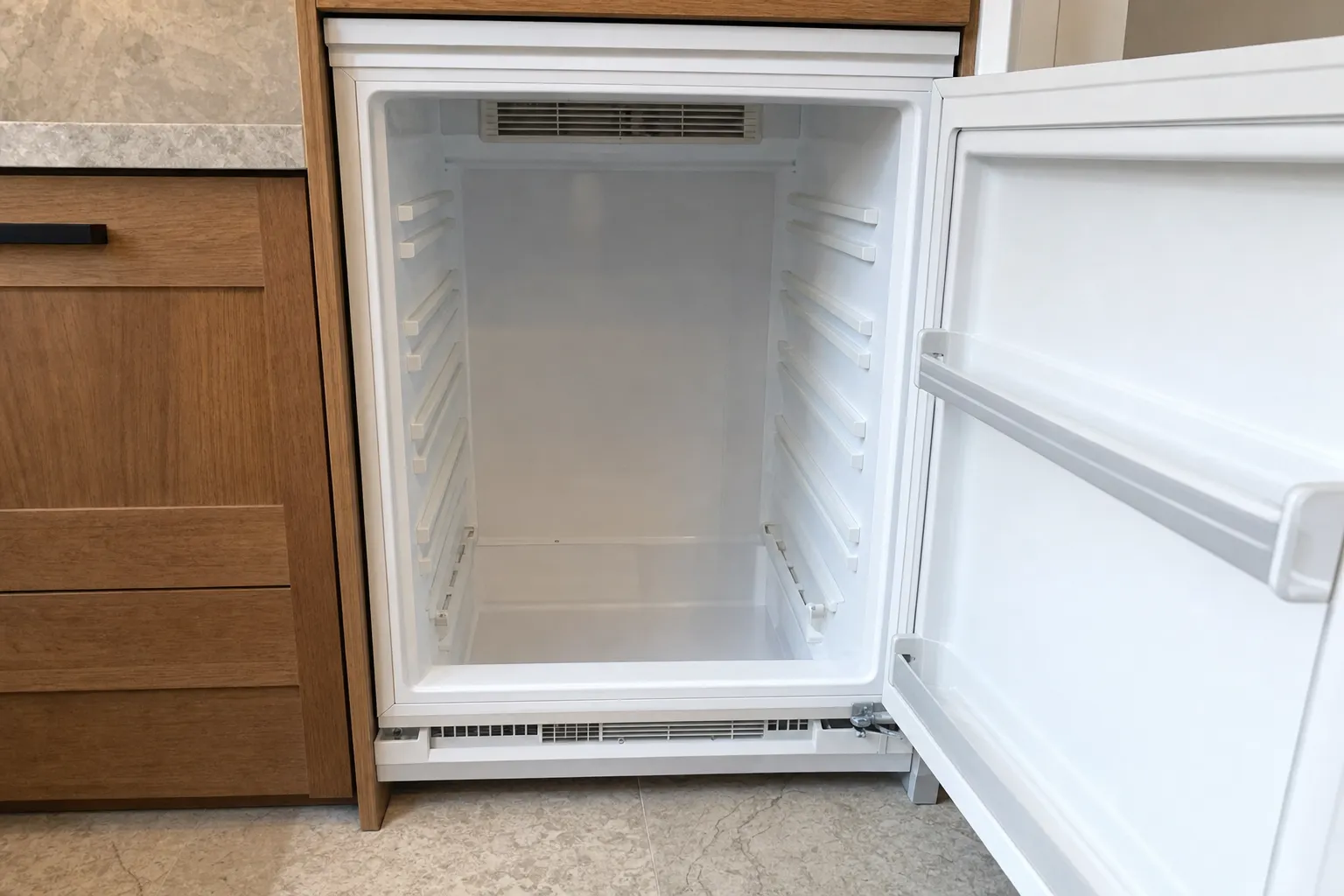
Two faults follow from that. A Viking refrigerator door is hung with a slight rearward attitude so that the last inch closes under its own weight; tip the cabinet forward and that assist disappears, the door eases back open, and the hinge takes the blame. A dishwasher out of level drains incompletely: water stands to one side of the sump at the end of a cycle, and eventually shows up as a wet line at the lower corner of the door gasket.
A panel-ready dishwasher shows it a third way. Its door carries a heavy custom front on two hinges, and once the cabinet under it racks out of square the front stops lining up with the drawer faces beside it: the reveal tapers, the door rubs or falls open faster than it should, and the gasket at the low corner no longer meets the tub evenly. That low corner is where the first drip reaches the floor. The fix starts at the levelling legs and the mounting brackets, not with a new gasket.
Look for the pattern rather than the part. If the refrigerator door on one wall has stopped closing itself and the dishwasher on that same wall has started weeping in the same season, you are looking at one cause with two symptoms, not two failed components.
Repair, or start again
Levelling is not a parts decision, which is exactly why it gets skipped. The order that works is: shim and re-level the appliance to the cabinet, re-set the door using the adjustment the hinge already provides, run it for a few days, and only then decide whether anything is genuinely worn. Components fitted before that step get fitted to a problem they cannot solve.
When it truly is a component, the work is priced from the six repair bands printed on each of our repair pages, and the figure is agreed before anything is fitted. The sealed-system band sits far above the other five, and on a cabinet already two decades into service that one figure tends to be the whole conversation.
Replacing the appliance is the wrong answer to a moving floor. A new unit dropped into the same opening inherits the same geometry, reports the same fault within a year or two, and you will have paid a great deal for a machine to tell you what a spirit level would have said for nothing.
What a diagnosis gives you
The visit costs $89. It produces three specific things: level readings taken at the appliance rather than guessed at, a fault named out loud, and a price agreed before anything is fitted. Down on the valley floor it also answers a larger question — whether you have one appliance in trouble, or a floor that is going to keep producing them.
That second answer is worth the visit on its own. A cabinet run that was shimmed once and has moved again is a building question, and it is much better to know that before the next appliance starts misbehaving than afterwards. Ring (206) 202-2799 or use the booking link on this page, and say whether you are down by the river or up the hill — it changes what we bring and where we look first.
Asked after reading this
Why will my Viking refrigerator door no longer close by itself?
Most often because the cabinet has lost its slight rearward attitude. The door is hung so that gravity finishes the last inch of travel; tip the unit forward and that assist goes away, so the door eases back open. Put a level on the top front edge and read the door reveal at top and bottom before buying a hinge or a closer cam. On the valley floor, a leaning cabinet is the more common answer.
Does the peat under downtown Bothell really affect kitchen appliances?
Indirectly, and only on the valley floor. The floodplain soils at the North Creek confluence are recorded as deep, poorly drained organic mucks and peats mixed with lake and marsh sediment, volcanic ash and alluvium. Ground like that compresses, so slabs and floor framing can shift over years. Built-in appliances are level-critical, so they report the movement as a door or a drainage fault. In Canyon Park or Queensborough, expect ordinary wear instead.
My dishwasher leaves standing water at the end of every cycle. Is that the pump?
Sometimes, but check level before you buy anything. Water sitting to one side of the sump rather than spread evenly across it points at a machine out of level rather than a failed pump, and that same tilt is what puts a wet line at the lower corner of the door gasket. A pump or control replacement is priced from the dishwasher band on our dishwasher repair page, so it is worth ruling out the free explanation first.
soils floodplainbothelllocal